
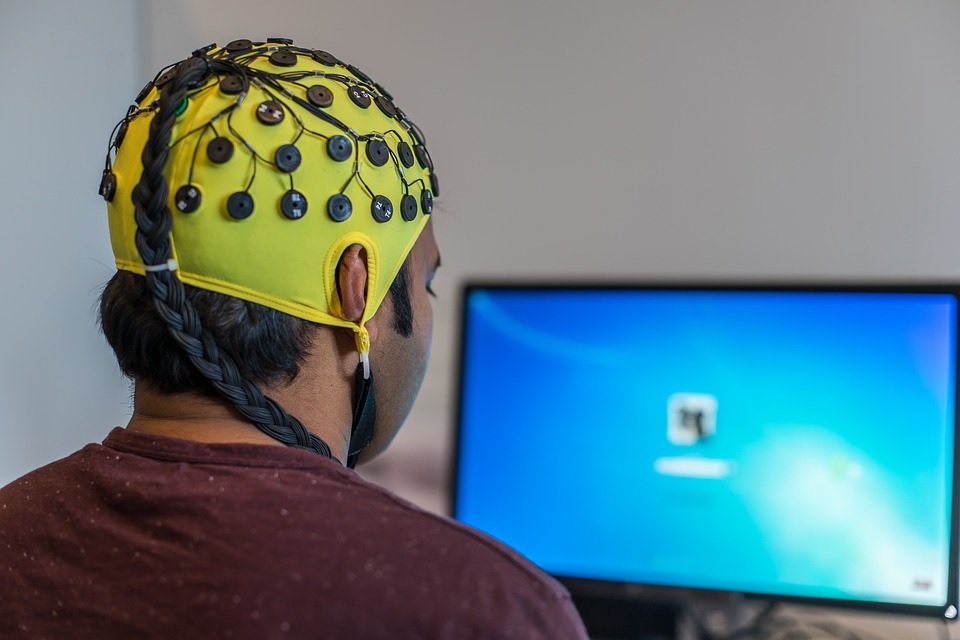
Brain Waves

We naturally emit sound waves from our bones, muscles, and brains in a very narrow spectrum range up to 125 hertz (Hz). There are five types of brain waves, each occupying a unique frequency range and each affecting the brain’s behaviour in different ways.

Gamma waves (40+ Hz) are associated with higher learning functions such as memory and information processing. Beta waves (12-40 Hz) are most active when we are awake and doing conscious tasks such as reading, writing, and socialization. Alpha waves (8-12 Hz) are known for bridging the gap between our conscious and subconscious minds, a transition stage helping us to relax and prepare for other brain wave activity. Theta waves (4-8 Hz) are active while sleeping and dreaming, and are associated with improving our creativity and intuition. Delta waves (0-4 Hz) tend to be responsible for deep healing and restorative sleep. Too much or too little of each of these types of brain waves can negatively affect the brain’s overall performance.

Brain waves are typically measured by EEG (the electroencephalograph) using electrodes placed at different points on the skull. Both the PET scan (positron emission tomography) and CT scan (computed tomography) use Xray technology. The MRI (magnetic resonance imaging scanner) uses electromagnetic projection and provides a clear image of soft tissue. The fMRI scanner functional magnetic resonance imaging machine) measures oxygenated blood flow.

Although the MRI and fMRI machines look very similar, they perform completely different functions. Where the MRI focus is on water and tissue density, the fMRI introduces the dimension of time measuring what is commonly referred to as BOLD contrast (blood oxygen level dependent contrast). As various stimuli are introduced, the fMRI shows where parts of the brain light up suggesting more neural activity in that area. Skeptics of fMRI technology question the assumed correlation between increased oxygen flow and increased cognitive activity, but this concern is diminishing every year.

The EEG and the fMRI are the machines most commonly used in creativity studies. Remember that the EEG measures electrical activity and the fMRI measures oxygenated blood flow. As more testing is done in this field, the correlation between the two is becoming stronger. Both can detect the position in the brain of the activity being monitored.

There are three main sections of the brain: the forebrain, midbrain, and hind brain. It is the cerebrum, or cortex, in the forebrain that is associated with higher brain function. Studies in creativity tend to focus solely on the forebrain, more specifically, in the prefrontal lobe.

Neurologic activity has been connected with many aspects of physical and mental health. Sound is one method of connecting brain activity to improved health and the medical profession is becoming more responsive to recommending sound-based solutions. This type of audio prescription, sometimes referred to as vibroacoustic therapy or audioceuticals, is relatively new in the medical field and it will be interesting to see how it unfolds.

Music Therapy and ROI

Healthcare costs in Canada between 2001 and 2011 rose at a rate of 6.7% per year, approximately three times the rate of inflation. This slowed to an average of 2.7% between 2012 and 2017, a direct result of government cutbacks and budget-driven fiscal restraint. Drugs are the second largest component of healthcare spending, with hospitals being first and doctors being third. From a goods-and-services perspective, pharmaceuticals represents the largest goods provider, and, as the infrastructure supporting the industry, hospitals and doctors the largest services providers.

In the United States, some of the top healthcare expenses are in mental health ($201 billion), falling down ($50 billion), and isolation/loneliness ($6.7 billion), all of which can be addressed through music therapy. One study suggests that workplace stress is responsible for up to $190 billion in annual U.S. healthcare costs.

The pharmaceutical industry is massive, estimated in 2016 to be $446 billion in the United States alone. The profitability of this sector is staggering with five of the largest pharmaceutical companies attaining profit margins of over 20%. One company (Pfizer) achieved a 2013 profit margin of 42%. Removing the one-time extraordinary event (the sale of their animal health business) still left them with a profit margin of 24%. Putting these figures into perspective, most manufacturing sectors are thrilled to attain profit margins (defined as what is left after all expenses are deducted) of 10%.

The pharmaceutical industry works hard to maintain this level of success. The estimated government lobbying effort in the United States for the industry in 2017 was close to $300 million. Keep in mind that this figure represents only the amount that pharmaceutical companies invest in manipulating government policy, that is, making sure politicians and bureaucrats support their agenda. At the risk of sounding pessimistic, their agenda may not be driven by the needs of their customers.

Information on the health benefit of music was, for many years, anecdotal. More recently, music journals (such as Approaches) have provided empirical data linking musical activity to tangible results. Non-invasive, non-chemical, community-based, and artistically-driven remedies are available. Connecting these musical remedies to savings in healthcare presents a financial argument that is difficult to dismiss.

From a return-on-investment perspective, using music therapy to ameliorate healthcare expense makes sense. Targeting pharmaceuticals in mental health (i.e. the largest goods expense in the largest issue expense) might provide the best return on effort. That is, follow the money. Music therapy already provides many medication-free solutions in the area of mental health; it is time to make a case for financial support. Music therapy is an efficient vehicle for maintaining good health, one that will continue to be well-received by communities, individuals, government, and healthcare professionals.

Big pharmaceutical companies may not support this initiative, and lobbyists will be quick to denounce the advancement of any solution that is not patentable. One example of a back-to-basics-drug-free expenditure is in Switzerland where they recognize music in their healthcare system as a means of mitigating the immobility associated with arrhythmic gait and seniors falling down. Costs are justified as being preventative measures against future liability, a business model that should be attainable by all jurisdictions, but governments are slow to make changes that are not optically impressive and supported by big business.

A realistic objective is to present the province with financial information linking specific healthcare costs with specific music therapy solutions. That is, provide the government with return-on-investment (ROI) justifications to make funding music initiatives in healthcare simple and logical (Rx Music 2020).