
Hertz Too Much

pianorose

A well-established fact is that people with certain forms of dementia, including Alzheimer’s disease, have decreased brain activity in the 40 Hz area. Recent research by Lee Bartel et al has shown that exposure to 40 Hz vibrations from an external source can, in as little as six sessions of 30 minutes each, have a significant impact on mental stability, specifically an average gain of 12 per cent on the total Alzheimer’s test.

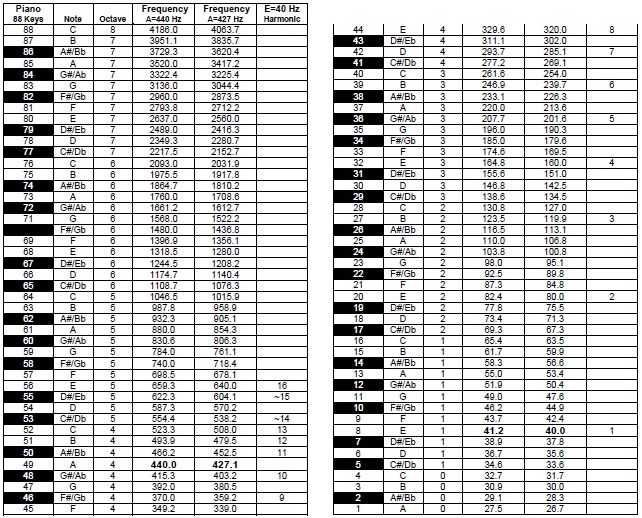
When the note A is tuned to 440 Hz, low E on the piano is at 41.2 Hz and low Eb is at 38.9 Hz (see chart below). Therefore, 40 Hz is located about halfway between low E and low Eb on the piano. 

What are the implications of a low E being close to 40 Hz?

The standardization of A at 440 Hz was established in the 1930s so that recording studios in New York could sync harmonically with recording studios in Los Angeles. Before then, there was no worldwide standard on pitch. A432 was commonly used because it had quasi-science notions of planet alignment and galactic resonance. But every country, even every city or concert house, had their own standard regarding pitch.

Many stringed instruments have an E as the lowest and/or most fundamentally important string, such as the lute, guitar, sitar, double bass, and electric bass guitar. And what about chanting and meditation? What pitch was the original meditative OM? Is a low E at 40 Hz where our forefathers intended our E to be?

Ancient medical practices were not developed without reason. Acupuncture is effective, and many herbal medicines, typically created over time through trial and error, inexplicably work. Did early civilizations gravitate to a 40 Hz fundamental in the pursuit of inner peace and harmony? Was 40 Hz the natural remedy for dementia? And did our society lose sight of the holy grail of pitches to accommodate the practical needs of business and the recording industry?

Using the equal temperament tuning system, which is the standard found on all modern pianos, A427 (versus A440) is where A would be if a low E were set to 40 Hz (see below). Tuning A to 427 Hz is not a major deviation from the norm. In fact, the tuning fork was invented in the early 1700s by Joseph Sauveur and he was the first to propose a standardized pitch, recommending a tuning convention of A at 427 Hz. Even 100 years later in 1811, the Paris Opera House was known to use an A427 for their orchestral tuning. Tuning A at 427Hz is based on a middle C at 256Hz, which has mathematical implications. That is, two to the eighth power is 256.

“Regarding composers, all “early music” scholars agree that Mozart tuned at precisely at C=256, as his A was in the range of A=427-430. Christopher Hogwood, Roger Norrington, and dozens of other directors of orginal-instrument orchestras’ established the practice during the 1980’s of recording all Mozart works at precisely A=430, as well as most of Beethoven’s symphonies and piano concertos. Hogwood, Norrington, and others have stated in dozens of interviews and record jackets, the pragmatic reason: German instruments of the period 1780-1827, and even replicas of those instruments, can only be tuned at A=430.”  Wikipedia

Is an A set at 440 Hz too high? If 40 Hz is the optimal frequency for brain connectivity, a standardized A at 427 Hz might provide our brains with the best aural environment for success.

As mentioned earlier, the Paris Opera House in 1811 tuned to A427. It would not be a stretch to imagine that the premiere of Mozart’s Adagio in E for Violin and Orchestra, composed in 1776, may have been performed using an orchestral tuning of A427 featuring a low E at an enlightening and brain-friendly frequency. 

As an interesting exercise in brain-massaging pleasure, I recommend listening to Mozart’s Adagio for Violin and Orchestra K261 at a tonal centre one half semitone lower than standard. The piece is written in the key of E and lowering the pitch by one quarter of one full tone using a program like Audacity, the piece becomes Mozart’s Adagio for Violin and Orchestra K261, written in the key of E and performed in the key of … wait for it… Eb and a half. Enjoy your 40 Hz fix!

WWBD: Identifying Malignant Narcissists

Bluto – Popeye FB

Much of our mental health journey revolves around optimising conditions to support an environment of mindfulness and peace. I have written in the past about the mental, physical and cognitive benefits found through experiencing music and community.

However, external forces beyond our control can shake the foundation of our ambitions and achievements. How can we push back against these distractions to maintain the serenity and calmness required for a healthy mind?

Popeye the Sailor was a 1960s cartoon depicting the seaside life of three individuals: Popeye the sailorman, Olive Oil the love-interest, and Bluto the angry bully. The Bluto character was large, bumbling and vindictive, and he served up much of the comedy in this classic cartoon. When angry, which was often, his eyes bulged and his nostrils flared. Malignant narcissists, for me, emulate Bluto and this imagery helps me disarm much of the natural reactions that tend to disrupt logical coherent thought.

In many ways, Bluto’s despicable behaviour represents a disturbing trend in today’s society; the general acceptance of declining decency, integrity and respect. The good news is that he presents himself with such ferocity and consistency that his behaviour (his Playbook) becomes obvious and predictable. Why is this good news?

It is good news because when encountering difficult individuals in our lives, comparing them to a known entity simplifies the list of available and effective relief mechanisms. Understanding other’s motivations and actions can clarify and help enable a better and healthier response. Of the many mental health disorders that may be attributed to Bluto, none shine so brightly as that of Malignant Narcissist.

WWBD: What Would Bluto Do? If the person causing you grief reminds you of Bluto’s behaviour, find below practical coping skills.

Wikipedia offers a quick and simple summary: Malignant narcissism is a psychological syndrome comprising a mix of narcissism, antisocial behavior, sadism, and a paranoid outlook on life. Lists of other attributes are well-documented, readily-available and can include, but are not limited to, the following:

Unaccountability
Doubling-down on personal opinions
Misdirected anger
Deflection from actual issues
Distraction from actual issues
Limited sense of humour and humility
Hatred of being challenged (i.e. fact-checked)
Hatred of being mocked or ridiculed (i.e. laughed at)
Hostility when confronted
Inability to handle criticism
Aggression and potential violence
Disregarding the rights of others
Content to create pain, frustration, and heartache in others
Lack of empathy
No remorse
Unapologetic
Tendency to blame others for their own bad behaviour
Self-centred, self-as-victim viewpoint

It is important for the malignant narcissist to control their self-as-victim story. In most situations, a narrative is developed that positions themselves in the best possible light. Alternate-facts are then created in support of their story. Dissenting opinions are unwelcome and the wagons circling their bubble are well-armed with falsehoods and vindictive attacks. Malignant narcissists display the attributes of a typically childish and insecure bully.

The main characters in the WWBD Playbook include the following:

  • The narcissist
  • The target victim
  • The audience
  • The fact-checker

    The Playbook character-list can be applied to any type of environment including business, society and family. In government infrastructure, the narcissist could be a political leader. The target victim could be anyone that does not fit into the narcissist’s narrative. The audience could be the general public. The fact-checker could be anyone or anything that questions the narcissist’s statements, and by definition they, too, then become a target victim. The Playbook is brutally simple and shallow. The audience is manipulated through distraction and repetition to focus on perceived threats. Anger punctuates all attacks. Facts are not necessary in this model and the bigger and louder the lie, the more likely the popular belief. The credibility of the fact-checker/target-victim is aggressively undermined and their attempts to sway the audience become more and more futile.

Applying a similar Playbook framework to our daily activity is relatively straightforward; identify the players and plug them in.

The malignant narcissist will seldomly address facts directly, choosing rather to divert attention to secondary or unrelated issues. Their distractions will position themselves as the victim and lead the audience to be victims as well, creating an environment of faux commiseration and support.

It is a fantastic time in our society to be a malignant narcissist. Accountability and integrity are rarely seen. Lying is expected. Division and outrage are fashionable. Victimization is a requirement. The state of society’s mental health is at an all-time low and hope can be elusive. Search online “victims of malignant narcissists” for more information.

What can we do to protect ourselves and our mental health against these vicious attacks on reality?

B L U T O

BOUNDARIES: Weak boundaries are readily exploited. Be as firm as possible with setting your terms of engagement but keep your expectations low. Boundaries are rarely observed and many (most) professionals recommend avoiding contact with malignant narcissists.

LET-IT-GO: Expecting fairness or an apology from a malignant narcissist is futile. Feeling shame is not part of their wheelhouse, nor is the possibility of a logical conversation, so let those go as well. Avoid contact.

UNDERSTAND: Distraction and deception are important parts of the WWBD Playbook. Statements are made to deliberately disrupt your line of thought and undermine your confidence. Be aware, be observant, be detached, be insightful.

TRUTH: Be strong. It may be necessary to expand the circle of avoidance to include audience members. Individuals that have fallen prey to the malignant narcissist’s distractions and deceptions are not necessarily against you, but their views can undermine your efforts for positive health and wellbeing.

OPTIMISM: Psychological manipulation is guaranteed and building an emotional resilience through networking and/or counseling can help. Search for a support community. We have control over our own actions and reactions. Keep it light and know that NONE OF THIS IS YOUR FAULT.

What Can YOU Do? You can understand the workings of the malignant narcissist mind, and, as difficult as it may be, try to act and react fairly and appropriately. Be a fact-checker. Call out deception and lies. Be aware of the malignant narcissist’s tactics. Audience members need to be fact-checkers. We ALL need to be fact-checkers because passive compliance creates casualties. A confidently delivered statement is not necessarily true (Dunning Kruger). Be vigilant. Be fair.

Take care of yourself. Keep humour close by. Join a choir. Help somebody today. A healthy mind is about community.